

Cost a Menu Item in Cambodia: A Simple Step-by-Step Guide
Learning to cost a menu item in Cambodia is the first step to pricing it properly. Many café and restaurant owners set prices by looking at the shop down the road, or by adding a little to what they think an item costs. It works until a supplier raises a price, an ingredient gets wasted, or the packaging turns out to cost more than expected, and the profit on each sale quietly disappears.
Costing means working out what one portion of a dish or drink really costs you. It takes a little time, but it’s the foundation of every pricing decision. This guide shows how, with a simple example.
Why It Pays to Cost a Menu Item in Cambodia
1. You can’t price well without it If you don’t know your cost, you don’t know your profit. A popular item can lose money without anyone noticing.
2. Costs change Ingredient prices rise and fall. A price that worked six months ago may not leave a profit today.
3. It shows where the money goes Some items cost far more to make than they seem. Others cost very little. Knowing which is which helps you decide what to promote.
4. It supports good decisions Whether to raise a price, change a recipe, or drop an item all depend on knowing the cost. Our post on how to raise prices builds on this.
Step 1: List Every Ingredient
Write down everything that goes into one portion, and the exact amount. Include the small things, such as sauce, oil, sugar, and garnish. They add up.
Step 2: Find the Price of Each Ingredient
Check your latest supplier invoices, and work out the price per unit, such as per gram, per milliliter, or per piece. For example, if a 1-liter bottle of milk costs $1.25 and you use 200 milliliters, that portion costs $0.25.
Step 3: Add Up the Ingredients
Multiply each amount by its unit price, then add them all together. This gives you the ingredient cost of one portion.
Step 4: Add Packaging
If the item is served in a cup, box, or bag, add the cost of the cup, lid, straw, napkin, or container. Packaging is often forgotten, and it can be a large part of the cost for takeaway items.
Step 5: Add a Waste Allowance
Some ingredients are lost to spills, trimming, mistakes, and spoilage. Add a small percentage to your cost to cover this. Your own experience will tell you how much. Five percent is a simple place to start. The United Nations FAO’s technical platform on food loss and waste explains why even small, everyday losses are worth measuring.
Step 6: Compare With Your Price
Divide your cost by your selling price, and multiply by 100. This is your cost percentage, the share of the price that goes on ingredients and packaging.
Cost percentage = (cost of one portion ÷ selling price) × 100
Whatever is left is your gross profit on that item, before labour, rent, and other running costs.
A Simple Example
These numbers are only an example.
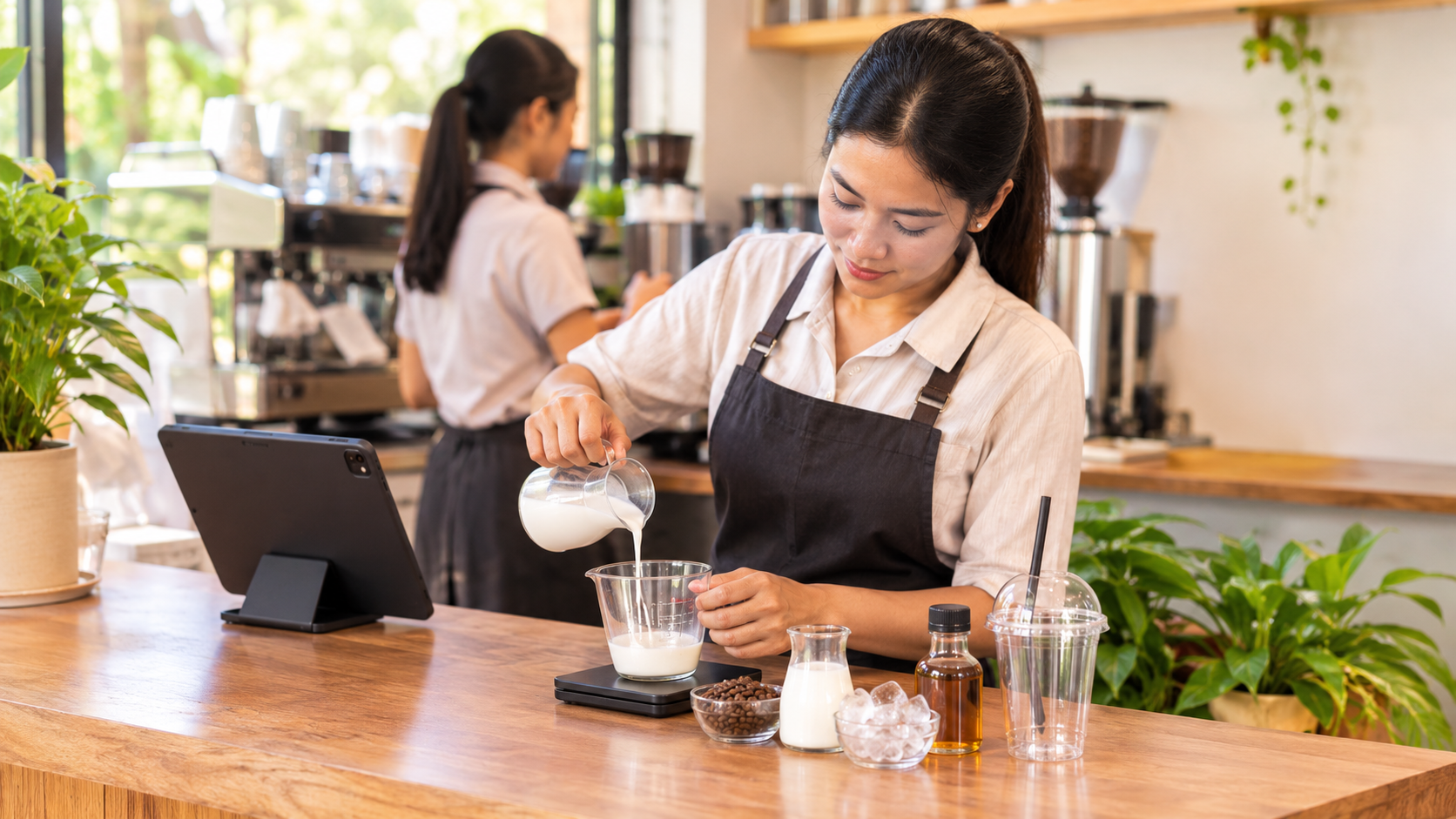
An iced latte:
| Item | Cost |
|---|---|
| Coffee beans | $0.20 |
| Milk | $0.25 |
| Ice | $0.03 |
| Syrup | $0.05 |
| Cup, lid, and straw | $0.15 |
| Subtotal | $0.68 |
| Waste allowance (5%) | $0.03 |
| Total cost | about $0.71 |
Selling price: $2.50.
- Cost percentage: $0.71 ÷ $2.50 = about 29%
- Gross profit per drink: $2.50 − $0.71 = about $1.79
Now suppose the price of milk rises by 20%, from $0.25 to $0.30 per drink:
| Before | After the milk price rises | |
|---|---|---|
| Total cost | about $0.71 | about $0.77 |
| Selling price | $2.50 | $2.50 |
| Cost percentage | about 29% | about 31% |
| Gross profit per drink | about $1.79 | about $1.73 |
To bring the cost percentage back to about 29%, the price would need to be around $2.70. You only know this if you’ve costed the item.
What’s a Good Cost Percentage?
There is no single right number. It depends on your type of business, your labour and rent, and what customers will pay. Some owners aim for a target cost percentage and adjust it to their own situation. The most important thing is to know your own numbers, and to check them regularly. The US Small Business Administration’s guide to managing your business finances makes the same point for any kind of business.
Remember that cost percentage covers ingredients and packaging only. Your labour, rent, and utilities must also be paid from your gross profit. Our profit and loss guide shows how to see the whole picture.
Don’t Forget Add-Ons and Options
Extras change the cost. An extra shot, a larger size, or a topping adds to the cost as well as to the price. Cost each option, so that what you charge covers what it costs.
When to Cost Again
Check your costs:
- When a supplier changes a price
- When you change a recipe or portion size
- When you change your packaging
- At least every few months, even if nothing seems to have changed
Which Items to Cost First
If you have a long menu, you don’t have to cost everything at once. Start with the items that matter most:
- Your best sellers. A small error in cost on a high-volume item costs the most.
- Your most expensive items, where a mistake is larger.
- Your newest items, to check they earn their place.
Our post on finding your best selling products shows how to find your best sellers.
How a POS Helps
A POS won’t work out your recipe costs for you, but it helps you decide where costing matters most, and see the results afterward.
1. Sales by item Reports show which items sell most, so you know which to cost first.
2. Set and update prices in one place Item prices are set in your catalogue, so when you change one, it changes everywhere.
3. See what your sales earn Sales, expense, and profit and loss reports show whether your overall profit is healthy.
4. Compare before and after Reports can be filtered by date, so after you change a price, you can compare sales before and after.
5. Check from anywhere The MyLekha Dashboard works on iOS, Android, and the web.
Quick Comparison
| Pricing by Feel | Pricing From Costed Items | |
|---|---|---|
| Knowing your profit per item | A guess | Worked out |
| When a supplier raises prices | Noticed late, if at all | You see the effect at once |
| Choosing what to promote | Whatever sells | Items that earn well |
| Setting a new price | Copying others | Based on cost and margin |
| Waste | Ignored | Included in the cost |
Getting Started
Start with your three best sellers. Write down the ingredients, check the prices, and work out the cost percentage. Most MyLekha customers load their catalogue and start selling within a day. See everything the system includes on our features page, or check current plans on the pricing page.
FAQ
How do I work out the cost of one portion? List every ingredient and its amount, find the price per unit from your invoices, add them up, add packaging, and add a small allowance for waste.
Should I include labour and rent? Costing an item usually covers ingredients and packaging. Labour, rent, and utilities are paid from the gross profit that remains, and show up in your profit and loss report.
How often should I re-cost my menu? Whenever a supplier changes a price, you change a recipe, or at least every few months.
What if my costs rise and I can’t raise my price? You could change the portion, adjust the recipe slightly, or raise the price on other items. Check your numbers first.
Does MyLekha calculate my recipe costs? This guide uses simple arithmetic you do yourself. MyLekha’s reports show your sales and profit, which help you decide where to focus and check the results.
Ready to See What Your Menu Really Earns?
See how MyLekha’s reports help you find your best sellers and check your profit. Start your free 15-day trial today, no credit card required.