

Handmade Seller POS Cambodia: Selling at Markets, Online, and Knowing What to Make Next
A handmade seller POS Cambodia makers can rely on starts with a simple need: know what you sold, and know what to make next. Handmade businesses are different from ordinary shops. You make small batches, sell in several places at once, such as a weekend market, a pop-up, a Facebook page, and maybe a small shop, and every product takes your own time to make.
When you’re busy making, selling, and packing, record-keeping is the first thing to slip. A few weeks later, you can’t say what sold best, what’s left, or whether you made any money. This guide shows how a POS fits into a handmade business, without turning it into a “real shop” before you’re ready.
What Makes a Handmade Business Different
1. Small batches and one-of-a-kind items You may make ten of one item and three of another. Stock is small, and each piece matters.
2. Selling in several places A market stall on Saturday, an event on Sunday, a Facebook order on Tuesday. Each place needs its own record unless they all go in one system.
3. No fixed counter At a stall or a pop-up, you have a table, not a till. You need something that moves with you.
4. Your time is a cost Every item takes hours to make. If your price doesn’t cover your time and materials, you’re working for free.
5. Deciding what to make next With limited time, making the wrong product is expensive. You need to know which ones sell.
Handmade Seller POS Cambodia: How It Helps Day to Day
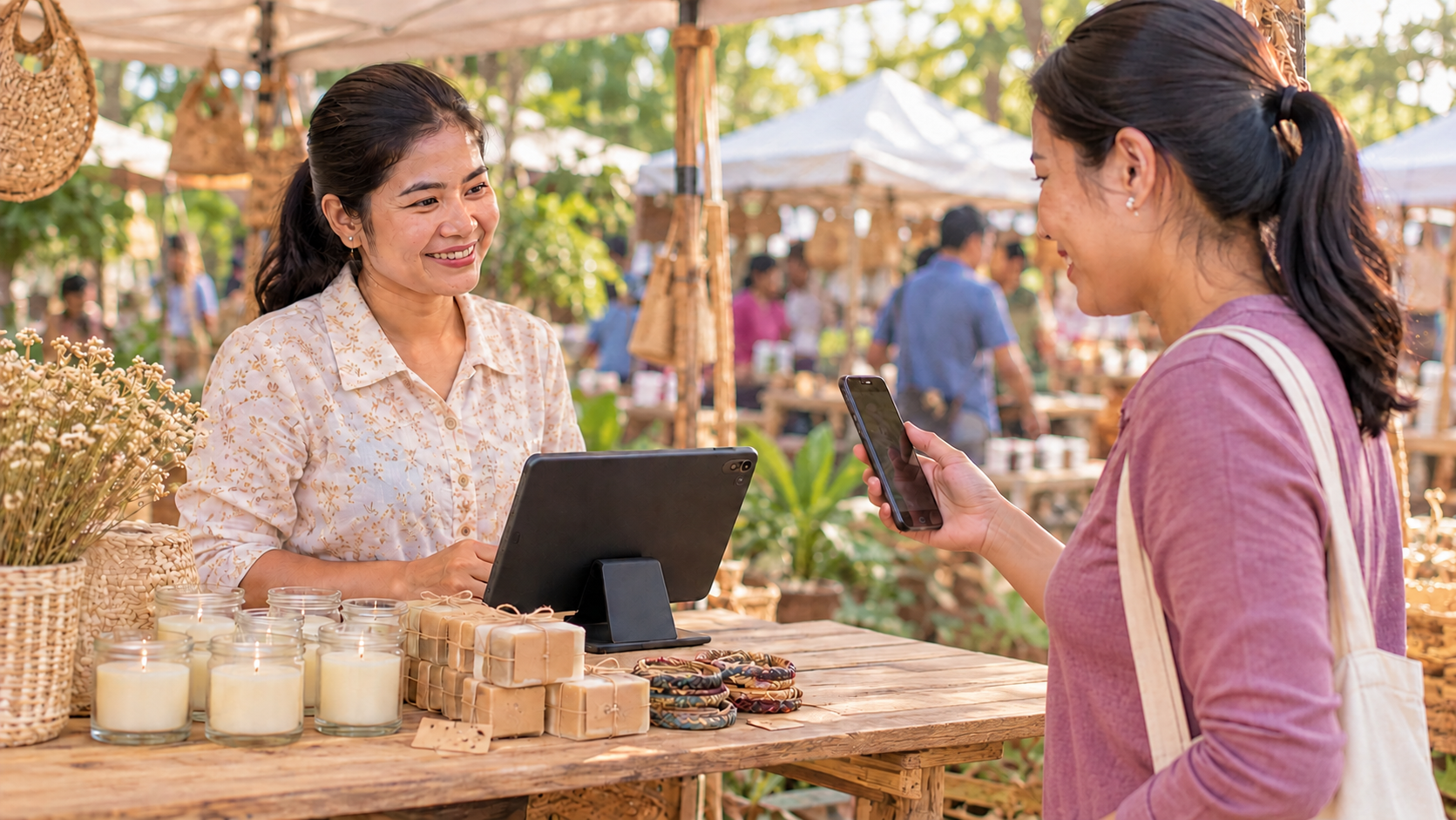
1. Sell from anywhere With a mobile POS on a phone or tablet, you can take sales at a stall, a pop-up, or an event, without a fixed counter.
2. Take the payments customers use Cash, KHQR, and ABA PayWay are supported at checkout, and MyLekha supports payments in USD or Riel, which helps when selling to tourists and visitors. Many market customers prefer to scan and pay. KHQR runs on Bakong, the National Bank of Cambodia’s payment system.
3. Record every sale in one place Sales from the market, the pop-up, and your page can all go into the same system, so your records are complete. Our post for online sellers explains how to enter online orders as sales.
4. Keep track of what’s left Every sale updates your stock, and you can adjust stock and run inventory counts. Before the next market, you know what to bring and what to make.
5. See what sells best Reports show your best sellers and slow movers by item and category. If one scented candle outsells the others three to one, you know where to spend your time. Our post on finding your best selling products shows how to read them.
6. Give a proper receipt Receipts print or can be shared as part of checkout, and can be customized with your business name and details, which adds a professional touch to a handmade product.
7. Check from anywhere The MyLekha Dashboard works on iOS, Android, and the web, so you can see your sales between events.
Pricing Handmade Products Well
Many makers charge too little because they leave out their own time. The US Small Business Administration’s guide to managing your business finances makes the same point. A few ideas:
- Work out the real cost of each item, including materials, packaging, and your time. Our post on costing a menu item uses a food example, but the same steps work for any product.
- Check your profit, not only your sales. Our profit and loss guide explains how.
- Raise prices when your costs rise. Our post on raising prices shows how to do it fairly.
Choosing What to Make Next
Before you plan your next batch, look at your sales by item for the last month or two. Ask:
- Which products sold out? Make more.
- Which products sold slowly? Make fewer, or change them.
- Which sells best at which place? A market may favor different items from your page.
- Which earns the best profit for the time it takes? Sometimes a faster, simpler product earns more.
This takes about ten minutes, and it can save days of making products nobody buys.
Keeping Business and Personal Money Apart
Many makers start with their own savings and personal accounts. As you grow, separate them. Record what you earn and what you spend on materials, fees, and transport, so you can see your real profit. Our post on expense tracking explains why this matters.
From Market Stall to Shop
If your handmade business grows, you may add a small shop, more staff, or a second location. Records you started early make that step much easier. Our post on growing a shop explains what each stage needs.
Quick Comparison
| Notebook and Memory | Handmade Seller With a POS | |
|---|---|---|
| Selling at a stall | Cash in a box | Mobile POS, with KHQR and cash |
| Records from different places | Separate, or none | One system |
| What’s left in stock | A rough guess | Updated with every sale |
| What sells best | A feeling | Reports by item and category |
| Receipts | None | A professional receipt |
| Checking sales | Counting at home | From your phone |
Who This Is For
- Candle, soap, and skincare makers
- Jewelry and accessory designers
- Clothing, bag, and textile makers
- Food gift makers, such as sauces, snacks, and baked goods
- Artists and craft sellers at markets and pop-ups
Getting Started
You don’t need a shop to start. Add your products, and try your first market with a handmade seller POS Cambodia setup on your phone or tablet. Most MyLekha customers load their catalogue and start selling within a day. See everything the system includes on our features page, or check current plans on the pricing page.
FAQ
Can I use it without a fixed counter? Yes. A mobile POS on a phone or tablet lets you take sales and payments wherever you are.
Can I take KHQR payments at a market stall? Yes. KHQR and ABA PayWay are supported at checkout.
Can I record my Facebook orders too? Yes. You enter each confirmed order as a sale, so your stock and records include online sales. MyLekha doesn’t need to connect to Facebook for this to work.
Can I see which products sell best? Yes. Reports show sales by item and category, so you can decide what to make next.
Is a POS too much for a small maker? No. A handmade seller POS Cambodia setup can be just one phone or tablet and your product list, and you add more as you grow.
Ready to Know What to Make Next?
See how MyLekha works as a handmade seller POS Cambodia makers can rely on: take sales anywhere, and see what sells best. Start your free 15-day trial today, no credit card required.